A heat seal tester is a laboratory instrument that simulates the heat sealing process used on packaging lines. Its main job is simple: help you find the right sealing temperature, pressure, and dwell time before those settings are fixed on production equipment.
Seal quality affects whether a package leaks, survives transport, or keeps its contents protected. On a production line, however, it is difficult to test many combinations of temperature, pressure, and time without causing waste or downtime. A heat seal tester solves this by allowing controlled, repeatable sealing trials in the lab. Once a stable parameter set is found, it can be transferred to the production line.
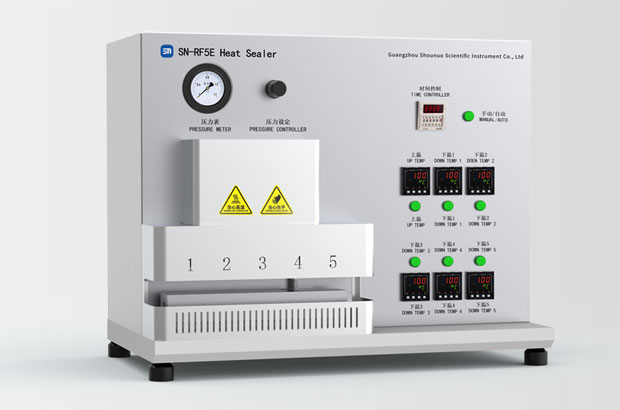
Most heat seal testers use a heated-jaw method. A sample is placed between upper and lower sealing jaws. A cylinder drives the jaws together, and the machine seals the sample at a set temperature, pressure, and dwell time.
Three variables matter:
These variables are not independent. Change one, and the other two usually need to be rechecked. A heat seal tester makes this three-variable testing repeatable, traceable, and easier to document.
Material development and incoming inspection. Converters and packaging companies often need to know the heat seal window of a new film or a new supplier batch. A wider window generally gives production more tolerance. A heat seal tester allows technicians to run multiple temperature points and locate the window boundaries.
Food, medical, and pharmaceutical packaging. Seal integrity is critical in these markets. Weak seals can lead to leakage, oxidation, or contamination. Samples prepared on a heat seal tester can later be tested for heat seal strength using a tensile tester.
Production parameter verification. When a line changes film batch, speed, or sealing jaw, the lab may need to verify the new conditions before production. A heat seal tester allows this to be done offline.
Common materials include plastic films, laminated films, aluminum foil laminates, metallized films, and paper-plastic laminates.
Heat seal testing is usually performed according to a recognized method, not just by sealing a sample and looking at it. Commonly referenced standards include:
Depending on the destination market, you may also need to consider FDA food-contact requirements in the U.S., EU food-contact regulations, and local requirements in Southeast Asia or the Middle East. When choosing a heat seal tester, confirm that the machine can cover the test conditions required by the standards your customers ask for.
Heat seal testers can be grouped by how many sealing temperatures they can apply in one run.
Single-point or dual-point models apply one or two temperature settings per test. If you need a temperature curve, you must adjust the machine and prepare samples multiple times. These models are suitable for routine incoming inspection or labs with lower testing volume.
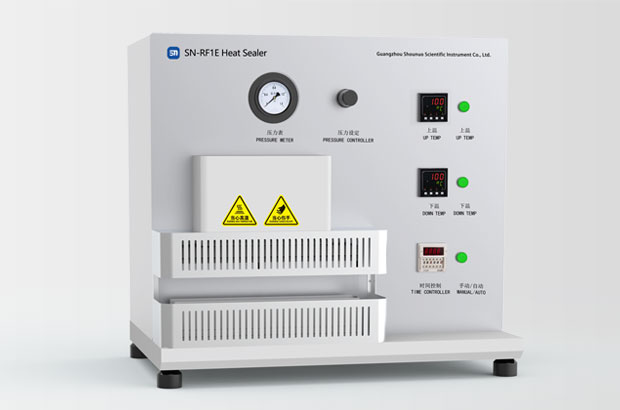
Five-point heat seal testers use five independently controlled heating zones. In one press, the machine can produce five seals at five different temperatures on the same sample. For example, Guangzhou ShouNuo’s SN-RF5 five-point heat seal tester is designed with five independently controlled heating units, a sealing temperature range of ambient +5°C to 300°C, and temperature control accuracy of ±0.1°C. The practical benefit is not only speed. It also improves consistency between temperature points because the samples are sealed under the same pressure and dwell time in one operation.
If your lab frequently screens heat sealing parameters, a five-point model can improve efficiency. If testing volume is low, a standard model may be enough.
Beyond brand and price, overseas buyers should confirm several practical details:
Temperature range and control accuracy. Many flexible packaging materials seal between 100°C and 200°C, but aluminum foil laminates and engineering films may need higher temperatures. Control accuracy affects repeatability. For many labs, a tolerance within ±0.5°C is worth checking.
Pressure control method. Air-cylinder-driven sealing jaws need a stable air supply. Some designs place the cylinder below the sealing area to reduce heat exposure and help maintain stable pressure output.
Sealing jaw size and surface. Jaw width and surface finish, such as smooth or serrated, can affect seal appearance and strength. Some suppliers offer custom jaw sizes for special package formats.
Operation and safety features. Foot switches, heat guards, and data export options can make a real difference in daily lab use. For overseas buyers, also confirm voltage, plug type, manual language, and any required safety documentation for your region.
A heat seal tester is not just a sealing machine for the lab. It is a process-development and quality-control tool that helps packaging teams connect lab results with production settings. Whether you are in Southeast Asia, Europe, North America, or the Middle East, the goal is the same: find a reliable heat sealing window, document it, and use it to reduce waste and seal failures.
If you are comparing models, start with the standards you need to meet, the materials you run, and the number of temperature points you test per week. Those three factors will usually narrow the choice quickly.
Previous article:This is already the first article
Next article:How to Choose a Bottle Cap Torque Tester: Range, Accuracy, Standards & Best Practices
Back
How to Choose a Bottle Cap Torque Tester: Range, Accuracy, Standards & Best Practices
14.09.2026
Packaging Solvent Tester – Detect Odors Before They Reach Your Client
07.09.2026
Package Leak Tester: Stop Costly Leaks Before They Happen
31.08.2026
Food Packaging Water Vapor Transmission Rate Tester
24.08.2026Scan
Add WhatsApp
Email
info@snlabtester.com
Business Inquiry
+86 13316049470
Free Hotline
+86 020-26221916