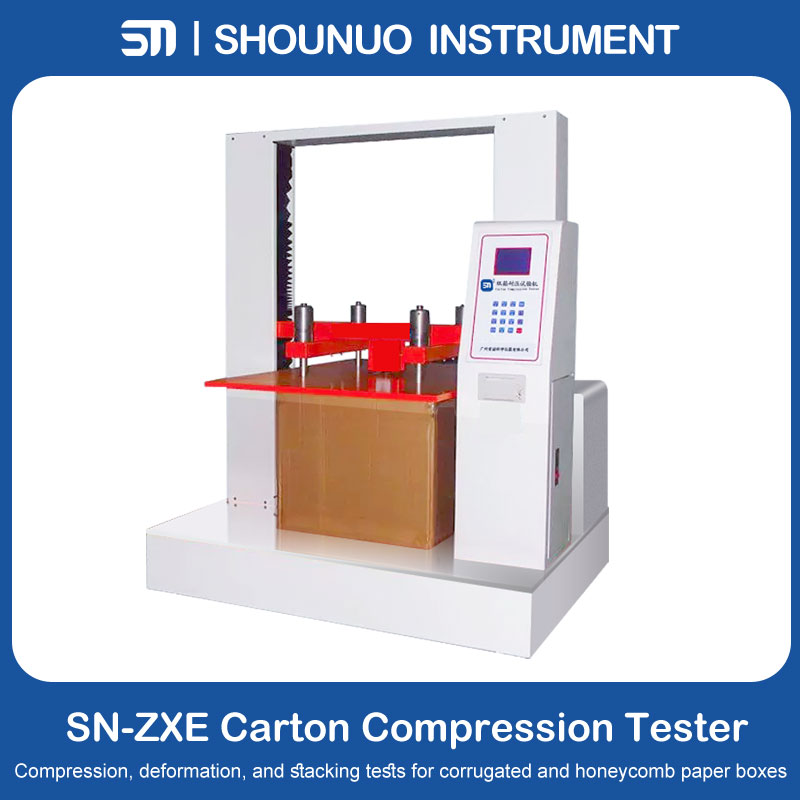
In the logistics and warehousing chain, the carton remains the most common packaging container. Its quality directly determines whether products reach consumers intact. To scientifically and accurately evaluate a carton’s ability to withstand pressure, the carton compression tester – also referred to as a box compression tester or corrugated compression tester – has become an essential quality‑control instrument for the packaging industry.
The core value of this equipment lies in its ability to simulate the real‑world external forces that cartons experience during warehouse stacking, long‑haul transportation, and manual handling. Through data‑driven testing, manufacturers can precisely determine the compression strength and stacking performance of their cartons, thereby reducing the risk of product damage and financial losses. Its practical applications are best understood through three key test types:
1. Compression Strength Test – Finding the “Breaking Point”
This test measures the maximum force and the deformation that a carton can withstand before it collapses under a steadily increasing load. Think of it as a “stress test” for the box. The results provide critical data for assessing whether the material and structural design meet the required strength standards.
2. Stacking Strength Test – Testing Endurance
If the compression test is a sprint, the stacking test is a marathon. It simulates long‑term storage in a warehouse. The machine applies a constant load to the carton and holds it for an extended period (e.g., 12 or 24 hours). The outcome directly answers a practical question: how high can finished cartons be safely stacked in your storage facility?
3. Pass/Fail Test – A Quality Gatekeeper
This function acts as a rapid checkpoint. You preset a target force or deformation value based on your specific transport and storage requirements. The tester then determines whether each carton meets that criterion, providing quick and objective support for packaging design and material selection.
Where Are These Tests Applied?
How Does a Carton Compression Tester Work?
The principle is straightforward: the machine drives an upper platen downward to apply a compressive force onto the test carton placed on the lower platen. High‑precision force sensors and displacement sensors continuously record every change in load and deformation. Modern instruments come with several user‑friendly features:
Compliance with Standards
To ensure authoritative and comparable results, a reliable carton compression tester must conform to a range of international and Chinese standards, including:
In summary, the carton compression tester scientifically simulates and quantifies the pressures that cartons endure throughout the logistics cycle. It delivers essential data for evaluating packaging quality, refining carton design, and ultimately protecting products in transit. More than just a testing device, it is a strategic tool for controlling packaging costs and enhancing brand reputation.
Previous article:Leak vs Seal Tester: Key Differences & Selection Guide
Next article:Packaging Bag Compression Tester: Selection & Testing Tips
Back
Packaging Solvent Tester – Detect Odors Before They Reach Your Client
07.09.2026
Package Leak Tester: Stop Costly Leaks Before They Happen
31.08.2026
Food Packaging Water Vapor Transmission Rate Tester
24.08.2026
Positive Pressure Seal Tester for Leak and Seal Strength Testing | ASTM F1140 & ISO 11607 Compliant
17.08.2026Scan
Add WhatsApp
Email
info@snlabtester.com
Business Inquiry
+86 13316049470
Free Hotline
+86 020-26221916