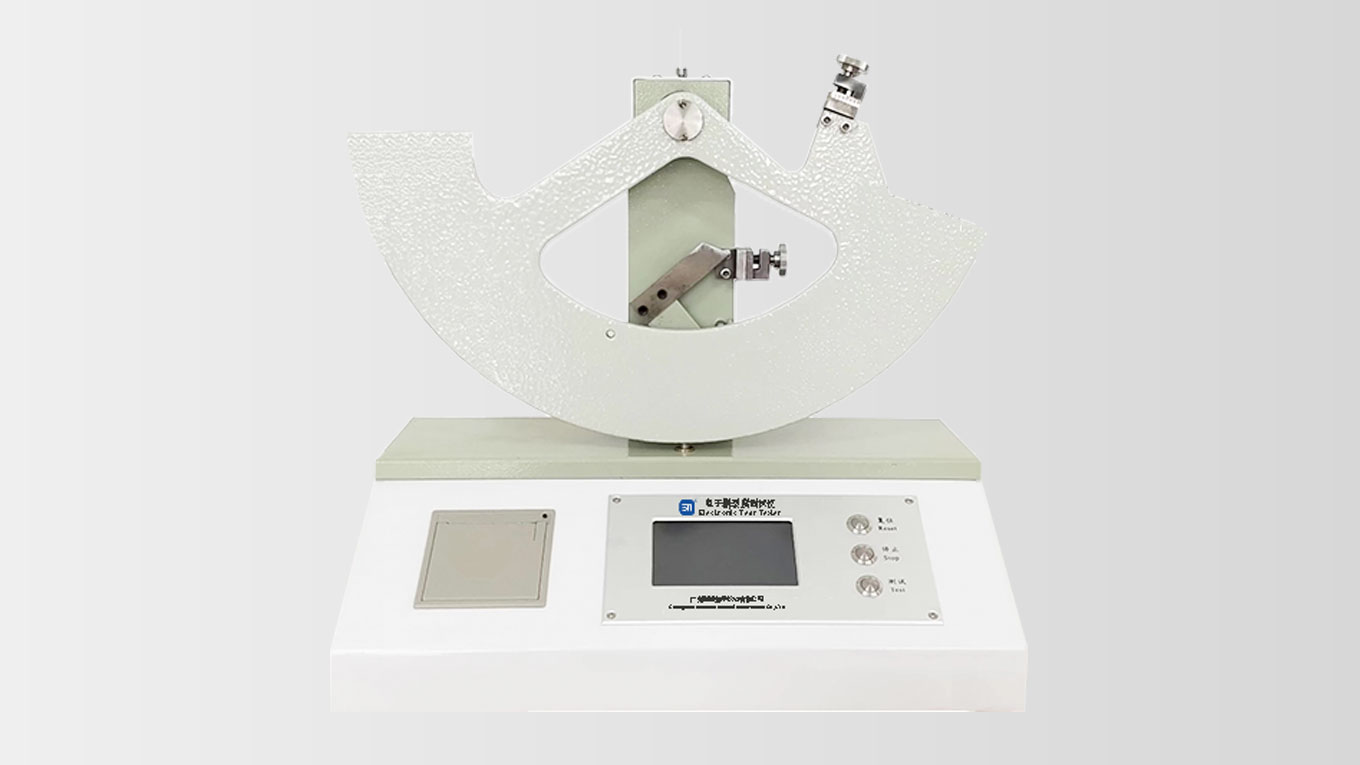
Intended Use:
Specifically designed for measuring the tear resistance of plastic films, sheets, flexible PVC, PVDC, waterproof membranes, woven materials, polyolefins, polyesters, textiles, and non-woven fabrics.
Operating Principle:
The pendulum is raised to a specific height to gain potential energy. Upon free release, the pendulum utilizes its stored energy to tear the specimen. By calculating the energy consumed during the tearing process, the force required to tear the specimen is determined (Elmendorf method).
Product Features:
- High-Precision Sensing: Equipped with a high-precision angle sensor, achieving a resolution of 0.1 mN and a measurement accuracy error within ±1%.
- Calibration & Compensation: Includes check-weights for on-demand calibration and a built-in friction compensation mechanism for the pendulum shaft, ensuring stable and accurate results.
- Smart Interface: Features a user-friendly HMI that automates the testing process. Includes statistical data processing and output via a built-in micro-printer.
- Third-Party Verification: Supplied with specialized calibration weights and an integrated calibration routine to facilitate verification by metrology and third-party calibration agencies.
Standards:
ISO 6383-1-1983、ISO6383-2-1983、ISO 1974、GB/T 16578.2-2009、GB/T455、ASTM D1922、ASTM D1424、ASTMD689、TAPPI T414
Application Fields:
Packaging | Food | Pharmaceuticals | New Materials | Chemical Industry | Printing
Technical Parameters:
Measuring Range
(10~64000)mN
Tearing Force Arm
(104±1)mm
Initial Tearing Angle
27.5°±0.5°
Distance Between Clamps
(2.8±0.3)mm
Specimen Slit Length
(20±0.5)mm
Power Supply
AC 220V/50Hz
Standard Configuration:
Mainframe, Power Cable, Thermal Printing Paper